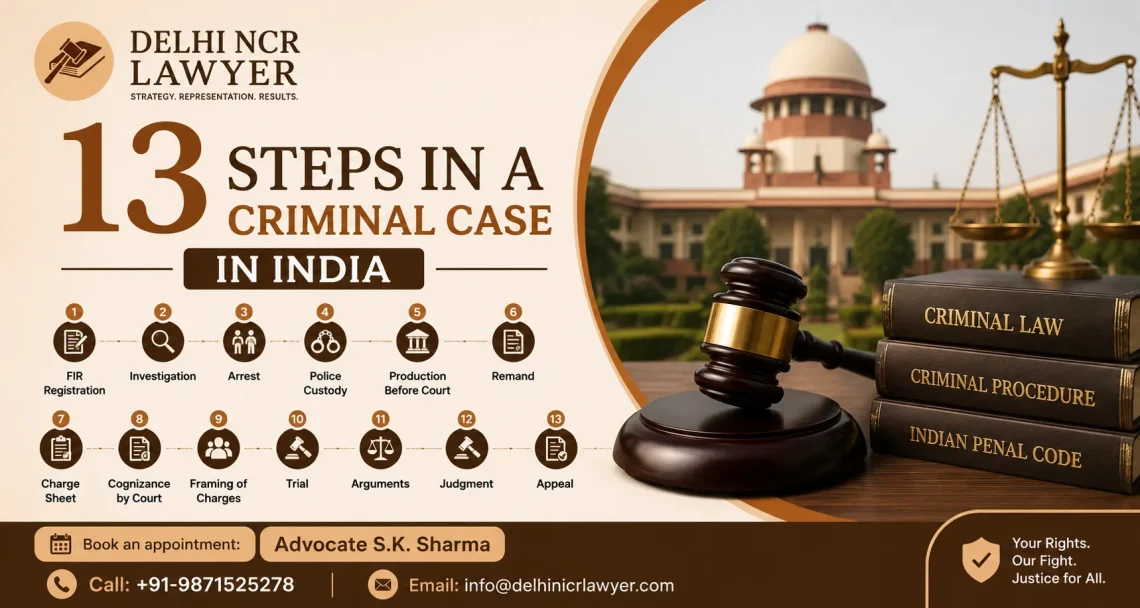
If you’ve just heard the word “FIR” attached to your name, or someone you care about has, the first feeling is almost never legal — it’s panic. What happens next? How long does this take? Do you need to appear in court tomorrow? Understanding the 13 steps in a criminal case in India won’t make the situation less serious, but it does turn a frightening unknown into something you can actually plan around.
This guide walks through the entire journey — from the moment an offence is reported to the final judgment — under India’s current criminal law framework, the Bharatiya Nagarik Suraksha Sanhita (BNSS) 2023, which replaced the old Code of Criminal Procedure (CrPC) from 1 July 2024. If you’re dealing with a case in Delhi, Noida, Ghaziabad, Gurugram, or Faridabad, the process below is exactly what you or your lawyer will be navigating.
A Quick Note on India’s Criminal Law Framework
Until mid-2024, three laws governed criminal cases in India: the Indian Penal Code (IPC), the Code of Criminal Procedure (CrPC), and the Indian Evidence Act. These have now been replaced by three new codes:
| Old Law | New Law (in force since 1 July 2024) |
|---|---|
| Indian Penal Code, 1860 (IPC) | Bharatiya Nyaya Sanhita, 2023 (BNS) |
| Code of Criminal Procedure, 1973 (CrPC) | Bharatiya Nagarik Suraksha Sanhita, 2023 (BNSS) |
| Indian Evidence Act, 1872 | Bharatiya Sakshya Adhiniyam, 2023 (BSA) |
The stages of a criminal case remain broadly the same in spirit, but several section numbers and timelines have changed — most notably, faster mandatory timelines for investigation, chargesheets, and judgments, along with wider use of electronic FIRs and video-conference hearings.
The 13 Steps in a Criminal Case in India
Step 1: Filing of the FIR or Complaint
Every criminal case begins with information about an offence reaching the legal system — either as an FIR (First Information Report) filed with the police for a cognizable offence, or as a private complaint filed directly before a Magistrate. Under BNSS, an FIR can now be filed in writing at the police station, electronically, or even (in the case of certain serious offences against women) at a place of the victim’s choosing. The FIR is the trigger that sets the entire criminal process in motion — nothing legally happens before this document exists.
What to do at this step: Keep a certified copy of your FIR, note the FIR number, and get the incident’s date, time, and details recorded accurately, since this document becomes the foundation of the entire case.
Step 2: Preliminary Enquiry (for certain offences)
For offences punishable with 3 to 7 years’ imprisonment where the facts aren’t immediately clear-cut, BNSS allows police to conduct a preliminary enquiry — with a senior officer’s permission — before formally registering an FIR, to check whether there’s a genuine case at all. This is a new safeguard specifically meant to reduce frivolous or malicious FIRs.
Step 3: Investigation
Once the FIR is registered, the police begin the investigation — visiting the scene, collecting physical and forensic evidence, recording witness statements, and, where the offence carries a sentence of seven years or more, mandatorily using forensic experts and videographing the process. BNSS has introduced firm outer time limits so investigations can’t drag on indefinitely.
Step 4: Arrest of the Accused
If the offence is cognizable, the police can arrest the accused without a warrant; for non-cognizable offences, they need a Magistrate’s prior permission. Arrest is not automatic in every case — BNSS continues to emphasise that arrest should be proportionate to the offence, and in many situations a notice of appearance is issued instead of an outright arrest.
What to do at this step: Know your rights immediately — you’re entitled to know the grounds of arrest, to inform a person of your choice, and to legal representation.
Step 5: Production Before a Magistrate
Any person arrested must be produced before a Magistrate within 24 hours of arrest (excluding travel time). Detention beyond this without judicial approval is unlawful. This step is a critical constitutional safeguard — it’s the court, not the police, that decides whether further custody is justified.
Step 6: Bail Application
Depending on the stage and nature of the offence, an accused (or someone anticipating arrest) can apply for:
- Anticipatory bail — sought before arrest, when someone fears being falsely implicated in a non-bailable offence.
- Regular bail — sought after arrest, to secure release from police or judicial custody while the case proceeds.
Bail hearings weigh factors like flying risk, tampering with evidence, criminal history, and roots in the community. A well-prepared application at this stage genuinely changes the course of the case — this is one of the areas where experienced representation, such as our criminal case services in Noida and Delhi, makes the most immediate difference.
Step 7: Filing of the Charge Sheet (Police Report)
Once the investigation is complete, the police file a charge sheet before the Magistrate, listing the alleged offence, the evidence collected, and the material against the accused, along with the FIR, witness statements, and forensic reports. If there isn’t enough evidence, the police can instead file a closure report, recommending the case be dropped.
Step 8: Cognizance by the Magistrate
The Magistrate examines the charge sheet (or complaint) and decides whether there’s sufficient material to take cognizance of the offence and proceed further. This is essentially a filter step — if the material is inadequate, the case can be dismissed here itself, before the accused is even formally summoned to trial.
Step 9: Issuing of Summons or Warrant
If the Magistrate proceeds, a summons (for less serious offences) or a warrant (for serious offences requiring the accused’s presence) is issued, along with copies of the FIR, chargesheet, and witness statements, so the accused knows exactly what they’re defending against.
Step 10: Framing of Charges
The court formally frames charges — specific written allegations — against the accused. At this stage, the defence can apply for discharge, arguing there’s no sufficient legal basis to proceed to trial at all. Our team’s approach to criminal case defence leans heavily on this stage — a strong discharge argument, backed by Supreme Court and High Court precedent, can end a weak case before it ever reaches full trial.
Step 11: Plea and Prosecution Evidence
Once charges are framed, the accused is asked to plead guilty or not guilty. If not guilty, the trial proceeds with the prosecution presenting its evidence and examining witnesses one by one, while the defence conducts cross-examination to test the credibility, consistency, and reliability of that testimony — often the single most decisive phase of a criminal trial.
Step 12: Defence Evidence, Statement of the Accused, and Final Arguments
After the prosecution’s case closes, the accused is given a personal hearing to explain the circumstances appearing against them, and the defence gets an opportunity to present its own evidence and witnesses. Once all evidence is on record, both sides present final arguments, drawing together the factual gaps, procedural lapses, and legal precedents that support their position.
Step 13: Judgment, Sentencing, and Appeal
The court delivers its judgment — acquittal or conviction — based on the evidence and arguments. If convicted, a separate hearing on sentencing typically follows. Either side unhappy with the outcome can file an appeal before a higher court — the Sessions Court, the Delhi High Court, or ultimately the Supreme Court of India, depending on where the trial was conducted and the nature of the offence.
CrPC vs BNSS: Key Sections at a Glance
| Stage | Old CrPC Section | New BNSS Section |
|---|---|---|
| FIR registration | Section 154 | Section 173 |
| Non-cognizable report | Section 155 | Section 174 |
| Anticipatory bail | Section 438 | Section 482 |
| Regular bail | Sections 437 / 439 | Sections 480 / 483 |
| Production before Magistrate | Section 57 | Section 58 |
| Framing of charges (warrant cases) | Section 228 | Section 251 |
(Section numbers can vary slightly depending on the exact nature of the offence and the specific chapter of BNSS applicable — always confirm the current numbering for your case with your lawyer.)
Why the Timeline Matters
One of the most common questions clients ask is simply: how long will this take? Under BNSS, several stages now carry firmer statutory timelines than before — investigations in specific categories of offences, filing of chargesheets, and even judgment delivery after arguments conclude. In practice, though, actual timelines still depend heavily on the court’s caseload, the complexity of evidence, and how efficiently each side moves at each of the 13 steps above. This is exactly why having someone track deadlines and file applications promptly — rather than letting the case drift — makes a measurable difference to how quickly it resolves.
A Note for Delhi NCR & Noida Residents
If your case falls under Delhi, Noida, Ghaziabad, Gurugram, or Faridabad jurisdiction, a few local realities are worth knowing: district courts and family courts handle the trial stage locally, while appeals and urgent matters like bail applications that don’t get resolved at the district level move to the Delhi High Court, or the Punjab & Haryana High Court bench for Gurugram and Faridabad matters. Jurisdiction quirks between these courts catch people off guard more often than you’d expect — particularly when a case gets transferred partway through. Whether you’re dealing with a criminal case as the accused or as someone whose complaint isn’t being taken seriously, working with a criminal lawyer in Noida who already knows these local courts saves real time.
Frequently Asked Questions
1. What are the 13 steps in a criminal case in India? Broadly: FIR/complaint, preliminary enquiry (where applicable), investigation, arrest, production before a Magistrate, bail application, charge sheet, cognizance, summons/warrant, framing of charges, plea and prosecution evidence, defence evidence and final arguments, and finally judgment, sentencing, and appeal.
2. How long does a criminal case take in India? It varies widely depending on the offence, the evidence involved, and the court’s caseload — straightforward cases can conclude in months, while complex trials can take years. BNSS’s tighter timelines are aimed at reducing this, but real-world outcomes still depend on how actively each stage is pursued.
3. Can a criminal case be resolved without going to trial? Yes — through discharge applications at the framing-of-charges stage, closure reports where evidence is insufficient, or, in specific categories of offences, compounding/settlement between parties where the law permits it.
4. What’s the difference between anticipatory bail and regular bail? Anticipatory bail is sought before arrest, to prevent detention on a non-bailable offence; regular bail is sought after arrest, to secure release from custody while the case proceeds.
5. Does the CrPC still apply to ongoing cases? Cases registered before 1 July 2024 generally continue under the old CrPC/IPC framework, while cases registered on or after that date follow BNSS/BNS/BSA. Your lawyer can confirm which framework governs your specific matter.
6. What should I do immediately after an FIR is filed against me? Avoid any direct contact with the complainant or witnesses, preserve any evidence or documents relevant to your side, and consult a criminal lawyer promptly — the earlier legal strategy begins, the more options (like anticipatory bail) remain available.
Conclusion
A criminal case can feel like a maze from the outside, but it isn’t random — it’s thirteen defined steps, each with its own purpose, safeguards, and opportunities to make your case. Whether you’re the person who filed the FIR or the person named in it, knowing exactly where you stand in this process is the difference between reacting out of fear and making informed decisions.
Facing an FIR, arrest, or ongoing criminal case in Delhi NCR? Don’t navigate the next step alone. Speak to a criminal lawyer in Noida at Delhi NCR Lawyer for a straight, no-pressure assessment of where your case stands and what to do next. Call or WhatsApp +91-9871525278, or write to info@delhincrlawyer.com — the first conversation costs nothing, and it’s usually the one that matters most.